
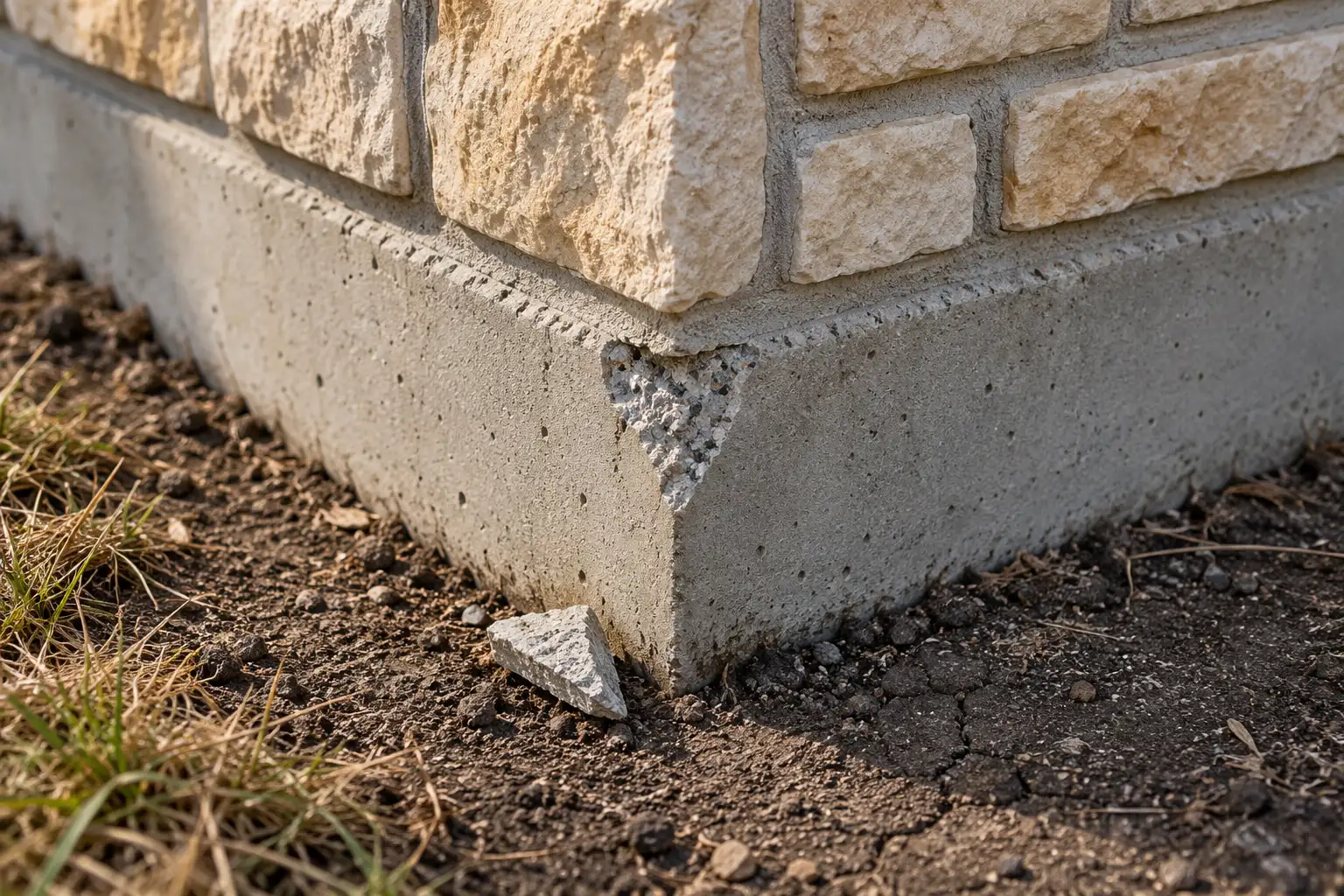
Round Rock, Texas · Slabs on clay or rock
Slab Foundation Repair in Round Rock, TX
Deep clay or shallow rock under the slab? The answer changes the repair.
A slab that has started to move usually shows it in small ways first: a crack creeping up from a door corner, a tile line that splits, a door that won't latch. Slab foundation repair in Round Rock, TX means finding why that part of the slab moved, then supporting it on something steadier than the soil that let it drop. Around Round Rock, that soil can be thick clay or limestone less than a foot down.
- Free inspection
- No obligation
- Town-by-town soil data
- You never pay us
- Call (737) 259-7007
What have you noticed?
A free inspection is the place to start. A house raised over a crawl space needs a different job, covered on our pier and beam repair page.
Signs a Slab Has Moved
- A corner or edge of the house that has dropped
- Cracks in drywall or stone that run from the corners of doors and windows
- Doors that stick or swing open on their own, in one part of the house
- Floor tiles cracking in a line across a room
- A gap opening between the slab edge and the brick or stone above it
The guidelines Texas engineers use list signs like these, then add that seeing some of them doesn't by itself mean a foundation has failed. A floor tilt over 1%, about 1.2 inches across 10 feet, is usually noticeable.
A crack says more once it's read. HUD's guide to older homes looks at how it runs: one that narrows from wide to a hairline points to faster settling, and clean, fresh edges hint that it moved lately. Size matters too: HUD's housing inspection standard draws its line at 1/4 inch wide and 12 inches long.
How Slab Repair Works West and East of I-35
Round Rock sits on a geological break. We sampled the USDA soil survey at 25 points per town, and the problem changes with the soil.
In the clay towns, the ground itself is the problem. Houston Black clay, 16% of our Round Rock sample and 48% of Pflugerville's, reads 12.0 on the USDA's shrink-swell scale from the surface down, with no rock in the top 80 inches. A paper by Houston-area repair contractors and consultants sets the goal of a drilled pier as support "below the active zone of the soil."
In the limestone towns, there may be very little soil to move. Eckrant, the top soil in Cedar Park and Leander, has limestone 8 to 11 inches down in every Eckrant map unit we read there. A slab that moves there deserves a hard look at water too.
On the break, Round Rock's own sample was 28% very high clay and 16% Eckrant over limestone, so two neighbors can need quite different repairs.
Whatever the ground, pressed concrete or steel piles go in beside the outside beam, and under the slab where they're needed. The weight of the house pushes each pile down until it stops sinking, or until steel piles reach the needed resistance or rock. Then the low part is lifted toward level and held there.
The Texas guidelines are frank about the limits. Piers don't improve the slab where no piers go, and lifting is unlikely to leave a floor perfectly level. Expect near level and holding steady.
What Slab Foundation Repair Costs in Round Rock
Published prices around Austin and Round Rock don't agree, so treat them as a range.
- A Texas repair company's 2026 Austin cost guide lists $350 to $500 per pressed concrete piling, $400 to $650 for steel and $450 to $700 for a helical pier. It puts a typical concrete-pile job at 8 to 15 pilings.
- Another Texas company with a Round Rock office lists about $1,000 to $3,000 per pier, and says most Austin homeowners pay about $3,500 to $12,000. Its lowest line is minor crack repair, at $500 to $1,500.
Pier count drives the total more than anything else. Add the permit fee and the engineer's plan, which one guide puts at $500 to $1,500. Our cost guide lines up every published price we found.
Why Go Through Us
We don't pour concrete or send out crews. Your call or form reaches us, and we hand it to an independent foundation repair company working in your town. It does the free inspection and any repair, and the contract is between you and it.
You never pay us. That company may pay us a fee for each request; our referral disclosure has the details. What we add is homework on your town's soil, permits and water rules, each from a public source. Other quotes are always fine.
The Steps, Start to Finish
- The free inspection. The professional measures floor heights across the house to map the low areas.
- An engineer's plan. Round Rock and Georgetown want a plan stamped by an engineer before they issue the permit. Round Rock's fee is $125; Georgetown's is $50 plus a $10 technology fee.
- Piers and the lift. Each pier can end at a different depth.
- A leak test. The Texas guidelines call for water and sewer lines to be tested after a house is lifted.
- A final survey. The floor is measured again. In Round Rock, a final engineered report is needed before the city's final inspection.
Over the Edwards Aquifer recharge zone, which covered 92% of our Georgetown points, it's worth calling TCEQ's Austin office at 512-339-2929 before any digging starts.
Questions About Slab Foundation Repair
Can't they just pump grout under the slab instead?
That's mudjacking. One company with a Round Rock office puts a whole mudjacking job at $1,000 to $3,000, the same range it lists for a single pier. The Houston contractors' paper calls it a shallow repair: if the soil's moisture changes, the slab can move again.
Will piers stop my slab from rising when the clay gets wet?
Not on their own. The same paper says the piers most often used under Houston-area homes aren't tied to the slab, so they can't hold it down if wet clay heaves. Evenly moist soil around the house helps the repair hold.
Towns We Serve
On limestone and clay alike: Georgetown, Cedar Park, Leander, Brushy Creek, Liberty Hill, Wells Branch, Pflugerville, Hutto, Manor, Taylor and Elgin. See all service areas.
Get a Free Slab Inspection in Round Rock
Tell us what you've noticed and your town or ZIP. A local professional will measure the floor and explain what they find, free.
What have you noticed?